Monday, February 11, 2013

Walk Softly and Carry a Big Stick


My Generation

Walk Softly and Carry a Big Stick

by   Rick Tavel© 1-16-13 All Rights Reserved

 One13thirteen has come and gone and the unveiling Chevrolet promised was everything that the loyal Corvette enthusiasts expected.  Though the final design was no real surprise to those of us who have been following it closely for more than a year, the renderings of the 2014 Corvette C7 from Jalopnik®, Car & Driver®, and others were strikingly close to the actual car unveiled Sunday to the media and which will be available to a hungry public later this year. 
But even though most of the renderings were surprisingly accurate, being able to see the real car added a “finality”, either good or bad, to the first step of passing the torch to a new generation of Corvette.  No longer can the traditionalists “hope” that the renderings were incorrect on the “Camaroesque” tail lights and somehow the round quads would actually show up in the final design.  The renderings weren’t wrong and they are pretty much just like rendered.  No longer can we hope the that a better “Orange” paint color would become available, it’s not, infact there is no “orange” for 2014 so Texas and Tennessee fans can send their complaints to GM.  But many hoped the “Stingray” moniker would return and it did to an overwhelmingly positive public. 
 
 In many ways the unveiling was similar to seeing your “mail order bride” for the first time, or a more appropriate twenty first century analogy, meeting that special person from the “chat room” with whom only photographs have been exchanged.  Photos technically do not lie but they can deceive.  But that is over, now we know, we’ve seen it and “What you see is what you get,” so to speak.   The designers and engineers at GM have given us what we have so excitedly anticipated; much of the speculation on the C7 has been put to rest.  The seventh in a string of exciting Corvette generations is ours, what we see is what we get! 

 I’m not going to rehash the hundreds of articles recapping every little detail of the last Sunday evening.  Suffice it to say, the initial response was overwhelmingly positive.  I think the biggest surprise was how few surprises there were.  How close the renderings were to “nailing” much of the new car’s design. 

Some may think that General Motors North American President, Mark Reuss’s use of, “breathtaking”, to describe the design may have been an over-exaggeration but, put in perspective, I can’t think of a single word more appropriate for our new Corvette.  Had we not been bombarded with hundreds of spy photos and “leaks” of the new design over the past year, few of us could have come up with a more accurate, descriptive word when the curtain was raised on the new “Stingray”.  Initial comments and reviews from the media who were privileged enough to see the car “up close and personal” praised the design of the body and the interior. And the media reviews appear to reflect the overall response from first time viewers where the response in one on line poll focused on the new look was running 86% “Love”, 9% “Indifferent” and only 5% “Hate”.   

 I am confident that there are thousands of GM employees that are breathing a little easier following the unveiling, knowing that the thousands of hours and the piles of money spent sweating, not only the “small stuff”, but every little detail of the new car “opened”  to such overwhelmingly positive reviews.   Those thousands of GM employees deserve to be proud of what has been achieved; take a minute, oh what the hell, take a day or two, sit back, toast each other, and get some well deserved rest because what you gave us on Sunday was only the foundation, the platform, on which the “greatness” of the C7 will be modified, refined and molded moving forward to remain the King.  Though the design was “breathtaking” and will serve the generation well we need to begin the process of insuring this car will remain the King of the Hill.  And I am sure you noticed some of the competition is working hard to take away that title.  So GM engineers rest up there is some major work ahead.

 In many ways the introduction of the C7 is similar to the introduction of the C5 in 1997 in the performance area.  What I mean is the generation will debut with a completely new engine design and few if any performance upgrades.  There will be no engines carried over from the prior generations as was the case (other than minor modifications) when the C2, C3, C4 and C6 generations previewed. Those engines had years of refinement and development and their performance assured the new generation a strong start.  If history is any indication based on the success of the all new LS1 introduced in the C5 back in 1997, maybe there is no need to worry about the new LT1. 
Hopefully the new LT1 engine is already being prepared to make an assault on the HP, ¼ mile, and top speed titles.   The simple fact is, like never before, the Corvette’s overall performance title is in jeopardy of being stolen.  Thankfully at this point the 2013 ZR1  has assured some breathing room,  comfort level if you will, helping secure the performance crown by besting one of the Corvette’s most dangerous competitors, the SRT Viper. You most likely have read how the ZR1 bested the Viper on the track, on the dyno and even in a “burnout” faceoff.  But as we all know fame is fleeting and the troops at Viper will mount another assault and we will have to be prepared with a more powerful, performance based version on the C7 once the ZR1 is retired at the end of this model year.

 Again if we look back at the C5 as a comparison, it took the team three years before the Z06 joined the performance battle.  I will be the first to say we do not have three years. Sometimes as being a part of the Corvette society we can become a little myopic.  If you haven’t taken the time recently to read up on what is happening over at the blue oval and even from Chrysler it may keep you awake at night. One of the major differences between 1997 and now is the sheer number of potential assassins on all levels, even from within our own  castle walls from the Camaro ZL1.  But perhaps the greatest threat will come from the new Shelby GT500, a real life “mouse that roared”.  The question is, “are we prepared?”  Are the engineers at GM well on their way to developing new weapons for the arsenal? 


Thought you’d like to see some official performance specs.


                         Corvette 2014             Corvette 2013            Corvette 2013 ZR1                 Camaro 2013 ZL1                     2013 GT500 Shelby
Engine             6.2-liter V8                  6.2-liter V8                   6.2-liter V8 Supercharged     6.2-liter V8 Supercharged      5.8- liter Supercharged

HP                    450@5,900 rpm         430@5,900 rpm          638 @ 6,500 rpm                    580 @ 6,000                             662 HP

Torque            450@4,400 rpm         424@4,600 rpm          604@ 3,800 rpm                     556 @ 4,200                             631

0-60                                                        4.3                                 3.4                                            3.9                                              3.7

Top Speed                                             190 MPH (est)              210 MPH (est)                       180 MPH                                   200 MPH
¼ mile                                                     12.6 @ 115                 11.4 @ 129.7                          12.1 @ 117                               11.8 @ 125


Those numbers are are as of today.  The GT500 numbers are the 2013 numbers and the “Blue Oval Boys” are working hard on the all new 2015 that according to them will completely dethrone the King.  Already enthusiast magazines are hailing the 2013 GT500’s engine as the best performance engine, bar none, that can be purchased at any price.  Concerning!  Quick hand me my Ambien, my Lunesta!  Better yet get me my “Jack”! 

 
 It would be interesting to know just how many Corvette sales have been generated because it is not only the “best” but also the “baddest” American production performance car that can be had.  How many buyers fork-over their cash, sign on the dotted line in order to won the best and the baddest?  Personally I don’t deceive myself, my days of pushing a ZR1 or Z06 to their limits have passed me by.  There once was a time….(but that is another story for another day).  So like so many others I am more than satisfied with my base C6 with the performance suspension and exhaust.  The car fits me and I love it, like I love my C5.  But I also like knowing that I drive a Corvette, the King of the Hill, even though with my diminishing racing skills and lack of performance upgrades another model ) a ZL1 or even a GT500 (with a competent driver) could hand me my ass.  It’s not that I brag about it or flaunt it I just take solace in knowing that “my big brother can beat you up!”  (Right about now I can hear my wife getting on the phone with my therapist.)  I think we all know what I am talking about.  As first year marketing students learn early on  about the buyer who goes into the showroom and spends hours looking at the Torch Red convertible and then sign on the dotted line for an Acadia, or the legendary stories about “Race on Sunday, Sell on Monday”.  There are as many reasons a Corvette buyer hands over the money as there are RPO’s.  And I think I could make a pretty good case that a lot of those reasons are tied to being number 1!  They may not buy the ZR1 or Z06, but just owning a Corvette gains the owner admission inside the battle scarred walls off retaining the crown.  And then ask how many of those “loyal” Corvette owners would still be waving the Corvette flag if it is continually being beat-up by some “lesser” automobiles?  Okay so it’s an oxymoron to call anything “lesser” if it bears the standard bearer.  (Sorry)

 Understand, I am not one of those “crepe hangers” and hopefully have no reason to be concerned.  As I have stated several times over the past year, the engineers at GM have done an outstanding job of delivering the best performance car on earth.  But “Forewarned Is Forearmed!”  I think nothing describes the Corvette any better than Campbell-Ewald’s® epic “Baseball, Hot Dogs, Apple Pie, and Chevrolet” advertising campaign.  Is there any symbol of our country more identifiable and appropriate than the Corvette? And as such America loves a winner.  We have a tradition of winning and it carries on.  We put our winners on pedestals and honor them, we try to learn from them, emulate them.  I am not advocating bragging and boasting but rather just having the tools to get the job done, to remain on the throne. 

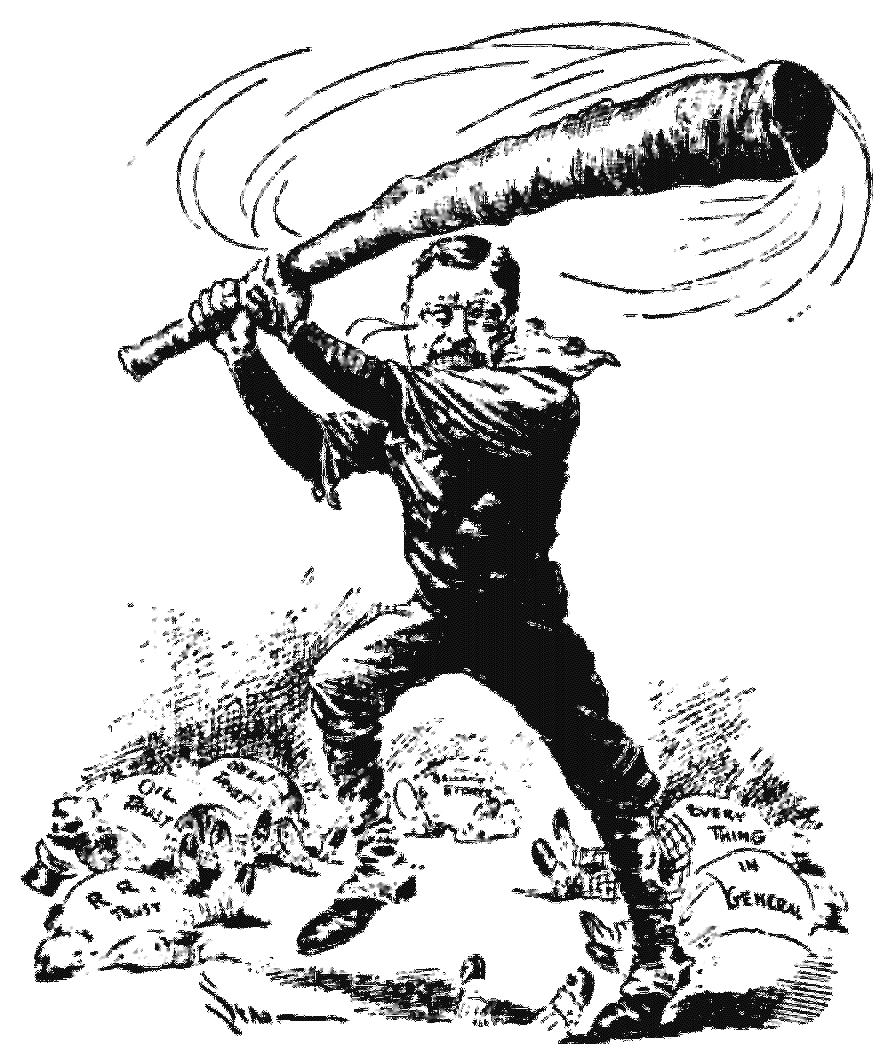
 As being a part of the Corvette round table I am confident that we will prevail.  We have all learned the importance of that Scout motto to “Be Prepared!”  And that is simply all I am advocating.  Being prepared.  We will continue to refine and develop the new C7 as we have other past generations to assure we retain the crown.  At this moment I think it would do GM well to subscribe to what Teddy Roosevelt proclaimed,    “Walk softly and carry a big stick!”


Saturday, February 9, 2013

Corvette Advertising Evolution throughout the Generations


Corvette Advertising Evolution throughout the Generations
by Rick Tavel© February 8, 2013 All Rights Reserved
Thanks to the Advertising photo sources: GM - OldCarAdvertising.com – Oldcarandtruckads.com

 
Over the next couple months we thought it would be interesting to look at the advertising and marketing of the seven generations of “America’s Sports car” and the steps GM® took to build their totally innovative concept car into one of the most enduring icons in our country’s history. Perhaps there is no other product in the United States which embodies our “national spirit” and aspirations, mirrors who we are and what we stand for like Chevrolet’s Corvette.  In 1962 Chevrolet’s ad agency, Campbell-Ewald, ran a Corvette ad that was far more profound than either the agency or Chevrolet realized at the time.  Not until we view the words from the historical perspective can we realize how prophetic they are, not only describing the Corvette enthusiast for whom they were written but more as a guideline for the future development of the car itself.   “Aficionados are made not born. Corvette enthusiasm, like manhood, is a condition that develops slowly and requires the tempering influence of experience.”  Ironically these words could also be the guiding mission statement for the Corvette’s development over the last sixty years - developing slowly and tempered by experience.

 
No other car model has endured and garnered the loyal, almost fanatical following of the Chevrolet Corvette.  Watching the car, along with its growing number of admirers, evolve from its tiny first year production of 300 cars in 1953 into not only the halo car of Chevrolet but the perennial “golden boy” of American performance automobiles is a fascinating journey.  Just as Campbell-Ewald’s early Corvette ad referenced the impact of a “tempering influence” on the enthusiast, the same can be said of the evolution of the Corvette itself, as it grew from concept, to initial production and finally to the culmination of the first generation in 1962.   This “tempering influence” kept the Corvette styling and performance on course and focused, not giving in to the latest styling whims and fancies.  Simply, it was more important to take the time to get it right, refine each generation’s performance over time until it was all that it could be.  Once again the ad agency spelled it out in a 1958 ad, stating, 
 “A great sports car is not made overnight.  It is developed and refined through years of testing and competition until its handling becomes silky smooth, its roadability flawless, its cyclonic power tempered to absolute reliability under the harshest demands.”  While the rest of the automobile industry spent time and resources on radical annual styling changes the engineers at Corvette spent time refining the car. 


 As we look at the Corvette’s marketing and advertising programs during each generation we have a much clearer perspective and a better understanding viewing the programs from the perspective of the major socio-economic factors and trends defining the era.  Viewed from this perspective a more accurate depiction and understanding of the advertisement can be garnered.

 
The C1 - 1953 through 1962

 When the concept of building and offering a two-seater “sports car” was conceived deep inside General Motors the corporation was by far the largest auto manufacturer in the world and was selling more cars than the rest of the American auto manufacturers combined.  In fact GM was so dominant they had to be careful not to capture “too much” of the market for fear of being broken up under the anti-trust laws.   Nevertheless, the new car designs and concepts already on the drawing boards and being readied for market at the time were poised to capture not only the needs but also the aspirations of America’s modern, post war society, a society radically different than that prior to the war.   The changes to our lifestyle was more dramatic than any in our history.  Tempered by a devastating world war and the life style changes which it prompted, from the growing ranks of women in the workplace to the more modern technology developed for the war effort now modified for domestic use, from an exposure to the lifestyles and cultures of other countries to the renewed commitment to home and family, the American people were ready to shed the 1940’s lifestyle and hungry to experience what the future promised.  The country had begun to transition from rural to urban living during the war, but the urban lifestyle failed to meet the needs of many of the people and families who moved into the urban areas to support the war effort so the exodus to the promised land of the suburbs had begun with the troops returning from overseas. 

 And by the early 1950’s General Motors was ready to meet the needs of this new society with modern, new products.  Not just mere facelifts to existing products but rather completely new designs taking advantage of the latest technology were developed, from appliances to automobiles. 


In order to hype the modern designs, GM revived its fleet of Futureliners,  customized buses designed by Harley Earl in the 1940’s used in GM's Parade of Progress, which traveled the United States exhibiting new cars and modern technology for consumers.   The fleet was temporarily retired until 1953 when the Futureliners were pulled out of mothballs to exhibit the newest technology and innovations GM had engineered for the fifties  everything from microwave ovens to robots were exhibited, whetting the public’s appetite for the products being developed.  The innovative buses toured the country until 1956 when “TV”, one of the technical innovations displayed in the 1940’s, rendered the buses ineffective.  One of the restored Futureliners sold at auction in 2006 for over $4 million.


During the early 1950’s some of the most beautiful, enduring automobile designs were introduced by General Motors.  This is not so much a surprise as an expectation since the corporation arguably employed the best designers and engineers in the industry.  Harley Earl, the most celebrated, talented American automobile designer penned not only the first concept of the Corvette but hundreds of other revolutionary automotive designs. Not surprisingly in addition to the Corvette, three other of Earl’s most modern and enduringly classic designs were introduced during the same time, the ’53 Cadillac Eldorado convertible, the ’53 Buick Skylark convertible and the ’53 Oldsmobile Fiesta Convertible. 
 
Originally introduced as show cars, these cars were produced and sold to tempt and whet the appetites for other GM products.  Due to General Motors’ sales success their corporate coffers were overflowing so finding the funds for the several new car designs on the drawing boards was a strategic move, positioning the company to take advantage of the profitable market ahead.  GM recognized the huge opportunity for fresh, modern designs and products to meet the needs of the more affluent post war economy, fueled by upwardly mobile families with the goal of home ownership and all of home ownership’s associated accoutrements. 


The years between 1953 and 1955 could have been labeled the birth date of the modern era of the automobile; it was marked with several revolutionary changes in not only design but also engineering that would carry forward and become the foundation of expanded offerings in the future.  In 1953 twelve volt electrical systems were offered on several models to handle the expanded optional power accessories like air conditioning, power windows, power seats, and of course, power steering which had become standard on several upscale models.  New engine designs were developed, introduced by mid-decade, and several early fifties “motorama” show car features made their first appearance in 1953 production cars.  The curved wrap around windshield, the “coke bottle” body styling, and the increased use of chrome, fins and other aeronautic suggestions were initiated in 1953 and made it the pivotal year for car design.

 
Many women who were employed to help with the war effort decided to continue as part of the workforce following the war, their additional income a welcome addition helping afford suburban homes and the modern conveniences available.  The move from crowded cities to the suburbs was fueled by the ease of home ownership through the Veterans Administration and the Federal Housing Administration. The move to the suburbs not only sparked new housing construction but also drove the manufacturing market segment producing the goods new home ownership required.  Of course perhaps the biggest benefactor of the move to the suburbs was the automobile industry.  It ignited the need for new, reliable automobiles not only to facilitate getting to work but for shopping, recreation, social activities as well as basic services.

 
America’s new prosperity, the decision of many women to remain in the job market after the war, the desire to start a family and own a home in the rapidly growing suburbs created several unprecedented opportunities in the design, function and marketing of the automobile.  It was no longer considered a tool, basic transportation.  It had become a comfortable personal statement about the owner.  There was no product more important in the post war society.  A car was a minimum basic requirement to a family in the suburbs, two cars were even better, particularly in households where both the husband and wife were employed outside the home.   The “two car family” also opened the door for an entirely new product category, a “specialty”  or “personal” car.   It made the feasibility of owning a two seat sports car possible. 

 
It also emphasized the need for the sports car’s antithesis, the station wagon.  During this period the family station wagon became one of the most important, profitable and popular models.  The station wagon met almost every need of a growing suburban family.   It was a comfortable family hauler, the supermarket shuttle, the nursery/landscape transporter and the perfect vehicle to take the family on vacation.  It could be had in the most basic economical model or it could be optioned to be as comfortable as any luxury car.  In 1957 Chevrolet alone had six different station wagons in their line-up.  The importance of this market segment was frequently illustrated by the number of expensive “double truck” advertisements, two facing pages in a newspaper or magazine, exclusively marketing a manufacturer’s extensive station wagon line up.


Identifying the dreams and aspirations of the country, tying the car’s persona to that of the country as a whole has been a staple of marketing Chevrolets, especially Corvettes.  The epitome of this advertising culminated in the “Baseball, hot dogs, apple pie and Chevrolet” ads of the 1960’s and 70’s, which will be discussed when we look at the marketing of the C2 and C3.  But when a 1950’s and early 1960’s Corvette ads are dissected they were no less of a reflection of America’s social and cultural trends focusing on successful lifestyles, whether it  be tied to sports, family and leisure activities.  
For example, though the target market for the new sports car was men, many who had become fascinated with European sports cars during the war, family men who were successful in business, many of the 1953 through 1958 Corvette ads were careful to often include a woman in the ad recognizing the emerging voice of women in the decision making process on all issues.  Among other trends marketing research companies, a new tool in the advertising agency’s arsenal, identified the importance of the woman’s (wife’s) input in the buying decision.  No longer was the woman’s input confined to domestic issues, no longer was a major purchase the exclusive domain of the male, so advertisers were careful to recognize this partnership and used it in every ad where appropriate.  This was not only a technique used by Campbell-Ewald but was used by all of the big three automobile manufacturers.

 
Not only was incorporating socio-economic trends important in creating the advertising and marketing programs for the new Corvette but accurately defining and reinforcing the car’s image, creating its “persona”, in advertisements was critical.  What was this new car going to be?  What was it designed to do? What was the target market and who was the target customer?  Remember Campbell-Ewald’s description defining the evolution of a Corvette enthusiast, “develops slowly and requires the tempering influence of experience”.  This appeared to be the guiding principal in regard to the Corvette’s evolution as well.  GM was not too quick to hang a tag on the car even though Harley Earl, Ed Cole and Zora Arkus Duntov may have had their own specific aspirations for the Corvette.  GM appeared to be content to allow the Corvette to “settle in” and give the buyers input into what they thought the car should be.  This may have been due to the fact that GM wasn’t sure if the “sports car” category would become viable in the United States and how it would shake out.

Keep in mind that very few people in the United States understood the concept of  “sports car” and aside from it being a small two seat car what were its other characteristics.  Sports cars had been spiritedly navigating European roads for decades but in the early 1950’s few Americans understood exactly what comprised this concept in cars.  Few understood that it was more than  a scaled down version of the large American automobile with two rather than four seats. Harley Earl penned the car and even though he was considered to be the most accomplished of all American automobile designers aside from the outward appearance of the car little differentiation from other American cars lay under the highly styled “glass-fibre plastic” body.  So when the Corvette was first introduced, though it was advertised as a “sports car” the term was nebulous and few people challenged the advertised terminology. 

 One of the first Corvette advertisements made a less than adequate effort attempting to describe some of the key points defining a sports car but in reality there was very little engineered into the car to back up the words. 
 Suspension, brakes and power were more suited to a regular production car than a “sports car”.  Further illustrating the misunderstanding of the sports car concept was advertising the two speed Powerglide automatic, the only transmission available for the car.  Zora Arkus Duntov thoroughly understood what a sports car entailed, especially from a performance perspective, but he did not join GM until 1953 so he had little impact on the performance underpinnings of the new car in its first years.  Nevertheless, as soon as he arrived he began his life-long objective of making the Corvette the best performance, sports car in the world.  Under his guidance the Corvette’s persona began taking shape as a car built to perform on the road and the track.  In early 1954 he wrote a scathing letter describing several ride and suspension problems which needed immediate attention in the car.

 Though the advertising gurus tried to market the inadequate 150 HP Blue Flame Six cylinder engine as powerful and performance based,  Duntov knew it was completely inadequate in its current form and unable to get the overweight 2900 pound Corvette to the winners circle.  He continually pushed for a larger more powerful engine that came to fruition in 1955 with the 265 cubic inch V8.  More importantly it resulted in the  vaunted fuel injected 283 cubic inch engine that when coupled with fuel injection produced one HP for each cubic inch of displacement in 1957, the engine that would serve as the foundation for GM engines for over a half century.


No one more than Duntov helped define the future for the Corvette as a true sports car.  He knew in order to qualify as a true sports car there were several modifications that needed to be made.  Not only did the suspension, handling, braking and engine need attention, in order to be considered a true sports car the car had to not only compete on the track against other sports cars it had to win. 


But before that could happen the future of the car needed to be assured and it was anything but secure after the poor sales results in 1954.  Because the 1953 small production sold out so quickly GM produced 3,640 1954 models which were difficult to sell.  It appeared the car was doomed and the Corvette would be discontinued prior to the 1956 model year.  After production of only 700 1955 Corvettes production was virtually stopped based on the poor 1954 results.  It seemed so assured that the Corvette would be discontinued the sports car was not included in the 1956 Chevrolet model line up advertising.

 Though several “official” reasons are given for reviving the doomed car at the last minute, most historians agree that it was Ford’s introduction of the Thunderbird that kept the car alive, GM not being “out done” by its biggest competitor.  The Thunderbird was never marketed as a sports car but rather a “personal car” that offered not only performance but all the amenities of the finest luxury cars, including roll up windows, something the Corvette did not offer until 1956.  GM realized that there were several changes necessary to keep the Corvette competitive in addition to the performance enhancements that Duntov had lobbied.


Realizing the necessity of competing with the Thunderbird, GM ramped up 1956 production with not only some of the performance changes Duntov had demanded but with several other amenities.   The Corvette received a V8 engine with dual four barrel carburetors, roll up windows, external door handles, a transistorized radio and even a hard top was offered as an option.   This was the first year for Corvette’s legendary “coves” to appear as a part of the design.  As a result of the changes for 1956 the first Corvette “competition” ad appeared and the Corvette was on its way to solidifying its emerging image as a true sports car.


 The next year saw the introduction of the legendary 283 cubic inch engine and coupled with fuel injection it was the first production engine to produce one horsepower for each cubic inch of displacement.  This engine continued as the foundation for all GM engines for the next half century.   The four speed transmission was also offered in 1957 helping to solidify the Corvette’s performance image and enhance both its road and track capabilities.  For the balance of the C1 production years aside from improved cooling capabilities with the introduction of the aluminum radiators and improved braking the introduction of the 327 engine in 1962 most of the new engineering and performance enhancements were being designed into Larry Shinoda’s revolutionary design of the 1963 Corvette C2.


Monday, January 28, 2013


MY GENERATION
The King Is Dead… Long Live the King
by Rick Tavel© 1-3-2012  All rights reserved.  Do not use without expressed written consent.

 There’s more than a few “Corvetters” over the top with excitement about 1-13-13. I admit that I am one of them. I mean, really, what do you expect? We’ve been conditioned over six generations for what will be revealed on Sunday evening in Detroit. It will be, if not breathtaking, at least the very best of sixty one years of the finest performance car produced in the United States. We will be bidding farewell to the C6, the finest of all generations of Corvette to date. Like the Corvettes of every generation they served us well as examples of America’s sports car. As we ready to welcome the C7, we read the results of the C6 taking the new Viper to task, on the track, the dyno, and the latest test, “burnouts”. Let me be clear, I’m not pushing the C6 out the door, I love my C6, the styling and the performance. But one of the reasons the Corvette has remained the King for over six decades is the never-ending mission of the engineers and designers at GM to improve it. And so it is with the C6, as good as it is it’s time to move on. It’s time to hail the new legacy, the heir to the throne which we will meet in only a few days.

I know some of you may not be able to remember the introduction of the second generation of Corvettes, but I do. When we were young, who among us did not stare, awestruck, the first time we laid eyes on the first Corvette of a new generation?  If you were like most, the unveiling of a new generation of Corvette completely captured our attention and our hearts.  It was an instant icon for almost every young boy whose dream would be to someday be able to own one.    Even Schwinn recognized the iconic status the car and manufactured a “Corvette” model bicycle from 1954 until 1964.  In 1963 the bicycle company unveiled the hottest bike a boy could own, their new “Stingray” model, coinciding with the introduction of the new Corvette C2.  From the perspective of our youth, the Corvette was the ultimate car, summoning emotional responses from deep inside us. 
 Most of us watched and waited every year for the introduction of the new cars and especially when a new generation of our favorite car was being unveiled.  The new generation Corvettes never disappointed us.  Not in our youth.  They were instant icons, legacies, born to inherit the throne of the auto world.  For those that can remember, the first thing you will recall is that each year we celebrated the new car introductions which took place in the early fall.  Most of the manufacturers held to the same timetable, so the unveiling of the new cars was a major event.  To add perspective for those too young to remember, each year every car was tweaked and changed and the public couldn’t wait to see what was new for the upcoming new models and changes.  It was a time when the styles were significantly different from one manufacturer to another.  So every fall we waited in anticipation for the changes each manufacturer would make.  Those of us addicted to Detroit’s four-wheel products loved to compare the old model with the new, noting the most subtle styling changes and of course, passing our expert judgment on the changes and tweaks the stylists had made. 

Unlike most of Detroit’s models, which often were the recipients of significant styling changes from year to year, the Corvette annual tweaks were subtle and to most, other than real “Vetters”, almost imperceptible. So, even the smallest changes to the Corvette were debated by its fans. After all, the King was the King, so any change had to be warranted and improve the car’s looks. Sometimes even the most insignificant change would either excite or incite us. If we look at the C2 as an example from 1963 through 1967 the major body styling went unchanged other than minor styling modifications. One modification Chevrolet made on the 1966 Corvette was changing the inside rear light on each side to a clear lens to accommodate the backup lights, which became a standard feature that year.

Being the foremost sixteen year-old Corvette authority, I was incensed that they would change all red quad lights, even if it were only the color of the lens.  All four of those lights were to be red!  I guess the same emotion was shared by most other Corvette enthusiasts since Chevrolet changed it back to the traditional red on the 1967 model year.   Speaking of the 67, I gave my complete approval and a double “thumbs up” when the hood scoop was changed to the “stinger-style” and the side vents went from three to five.  The point is, the analyzing the subtle annual changes allowed us to hone our abilities to be able to critically review and, of course, comment when a completely new generation of Corvette was unveiled.  If the annual unveilings were excitedly anticipated, you can only imagine the ‘over the top” exhilaration when a major styling change was made and a new generation, a new dynasty of Corvette ascended to the throne. 

 For as far back as I can remember, I was a huge fan of the Corvette.  And why not?  The car embodied all of the things every adolescent boy wanted to be.  It was good looking, stylish, strong, fast, well-built and it attracted girls!  I read everything I could find on the king of cars and of course would never miss spending sixty minutes each Friday night with Todd Stiles, played by Martin Milner, and Buzz Murdoch, played by George Maharis, as they adventurously traveled Route 66, which also coincidentally was the TV series name.  As far as I was concerned it didn’t matter who played who because the only real star of the show was the car, the Corvette.  The plot, if there was one, didn’t matter either, it was only about the car.

One of the benefits of the show was that after the first year, Todd and Buzz always started the new season with a new model Corvette, 1960 C1 for the first season, then a 1962 for the second, the third year they got the new generation 1963 Sting Ray and the final season ended with a 1964. So each week the viewer could watch the latest model of Corvette in action.  The TV show generated a lot of excitement, especially the fall of 1962 when it transitioned from the 1962 generation one car to the 1963 generation two car.
 
Many of the series followers, like me, watched because of the car, especially to see the radical new styling of the C2.  It seemed that everyone wanted to “weigh in” on the car’s styling and design.

I remember a lively discussion one September, Saturday morning at Ed Parks Barber Shop, among those waiting for haircuts, debating the styling of the newly introduced 1963 Corvette Sting Ray.  Mr. Parks, the barber, along with two other men were convinced that the new styling would surely spell the end for the sports car (sound familiar?), it was just too radical.  Keep in mind the only 1963 Corvette that Ed and his two friends had seen was on “Route 66”, the TV series, and in Corvette advertisements.  Two college guys waiting their turns in the chair disagreed with Ed and the others.  One of the two, his name was Mark, had actually seen a real Sting Ray.  He found it in a dealership in Cincinnati, Superior Chevrolet if I recall correctly.  I had

considered “thumbing” a ride to a dealer just so I could memorize every line and detail of the new car, but I couldn’t find one that had a car close enough to where I lived.  Okay so I was still kind of a wimp!  So I hung on Mark’s every word as he described the Sebring silver coupe sitting in the showroom.  I was quick to add my support of his opinion, it was the most beautiful automobile creation I had ever seen, and I was just as quickly ignored by my barber and his friends.  To support his opinion, Mark added that the new car was such a success there was a three to four month wait for a new one.  It cost over $4000.  In response the barber added that it was “foolish” to spend that kind of money on an impractical car “like that” when for a few hundred less you could buy “a real car, a fully loaded Merc Monterey Convertible”.  A Mercury for God’s sake, how could anyone even refer to a Mercury in the same sentence with a Corvette, I thought!  

Mark’s friend, who currently drove a tired five year old 1957 Corvette and boasted he was just two “points” away from losing his license, informed the small shop that he was saving up half the cost of a new Sting Ray and along with his trade-in could afford to finance the thousand dollar balance.  I could see the “disapproval” in the older men’s eyes, but his plan seemed to make perfect sense to me.

 There were only two things resolved in Ed Park’s barber shop that day, neither of them about the Corvette.  One was the unanimous opinion that our high school football team was destined to win another, in their long line, of state championships and the second thing resolved that day was when I got to high school I wasn’t going to let Ed “the barber” touch my hair again.

 The 1963 C2 proved the “barbershop experts” wrong.  To say it was a huge success was an understatement, producing and selling 48% more cars than 1962, the last and largest year of the C1’s production run. Aside from the car’s initial launch, that was the first of Corvette’s successful generational launches.

By the time we got around to the Corvette’s next generation and launch it was a year filled with political and social events which could easily cast a foreboding shadow on the new C3’s introduction.  Couple those events with the competition from inside the auto industry and the coronation of the new King appeared to be vulnerable.  As was the custom, the 1968 model year cars were introduced in the fall of 1967, a year steeped in anger and protest.  Just two months prior to the release of the C3,

Detroit was torn apart by the angry summer riots which had set many of the major cities in the United States ablaze in protest over discrimination and lack of jobs.  The violent summer of 1967 seemed to overshadow everything else, everything except the escalating Viet Nam war, the anti-war protests, and most of all, the tragic lost lives of over 15,000 American soldiers. 


Political and social controversies, however, were not the only things with which the launch of the new generation of Corvette had to compete.  The auto industry itself had even threatened a possible new model delay due to the almost impossible task of dealing with the Federal government’s safety and Smog standards.  But an even greater threat to a successful unveiling, unlike the 1962 introduction of the C2, the new C3 had to compete with the new wave of “specialty” (re: pony)  and muscle cars.  In 1962 the new Corvette C3 had most of the American performance market to itself.  But 1964 saw the introduction of the hugely popular Ford® Mustang, as well as the performance based and rebadged Pontiac Tempest turned GTO.  David E. Davis, editor of Car & Driver® magazine, validated the entire muscle car movement when he published an article in March of 1964 claiming the Pontiac GTO was faster than the Ferrari with the same name. Then Davis added insult to injury to Ferrari fans when he stated that Ferrari never built enough GTOs to earn the name!  The muscle car and “specialty” car market exploded so by the time the C3 was introduced in the fall of 1967 the market was flooded with performance cars of every type.  There were even some intruders into the two-seat sports car market.  The Shelby Cobra the only other true American “sports car” ceased production in the US in 1967, the same year the Corvette C3 was unveiled, but American Motors jumped in to the two-seat sports car market with the introduction of the AMX.  If we look at the new car specialty/performance market we find there were no less than fifteen competitors to the Corvette from GM, Ford, Chrysler, and American Motors.  GM, who at that time controlled over 50% of the domestic market and was bigger than the rest of the US automakers combined, fielded six performance competitors to its only sports car: Camaro, Firebird, SS396, GTO, 442 and the GS400. 


 Withso many ominous events taking place throughout the country and so much competition from other performance based cars it would seem that the introduction of a new generation of Corvette would have gone almost unnoticed. Not so. Automotive magazines hailed the car’s styling, referring to it as a“dream car”. Like the generation before, the car had a radical styling makeover. The C3’s styling, based on the Chevrolet Mako Shark II concept car and designed by Larry Shinoda, was flamboyant to say the least.  Car&Driver® praised it as the
“newest looking of all the 68’s” but noted that the chassis, suspension, brakes and engines were the same as offered in the 1967.

The automobile journalists praised the new body style for the ability to mount wider tires which the C2’s wheel housings wouldn’t allow.  They also found the removable front part of the roof, in two sections, to be innovative and compared it to a Porsche® Targa except that “the Corvette’s is in two sections separated by a center bar.”  The term “T Tops” had yet to evolve.   

 Unlike the introduction of the C2, I wasn’t going to miss seeing this car in person the day it hit the dealerships.   By this time though, I had my own license and owned a 1962 Corvair, the closest thing I could afford to a Corvette, so I did not need to “thumb a ride” as I had considered five years before.  My best friend’s girlfriend’s father owned a small Chevrolet dealership and I had heard that a larger dealership in Cincinnati was getting a new 1968 Corvette a few days prior to the introduction to the public for some public relations function.  After pleading and promising her father everything from cutting his grass forever to assuring my best friend would get his daughter home on time for the rest of the year, he agreed to get the Cincinnati dealer to allow us to see the car, even though he never wanted my ransom.  I think he realized that he was looking at four future customers for his small dealership. 

 My friends and I all had a pretty good idea of what the new car was going to look like.  We knew it was to be based on the Mako Shark II concept car which had been written up in most car magazines for more than a year.  In addition the car magazines had been teasing the public with “spy photos” for almost six months before the actual introduction.  Being a devoted reader of

Road & Track®, Car & Driver®, Hot Rod®, and Motor Trend®, I was pretty convinced what I would see at the dealership.  The four of us piled in the car to make the trip across the Ohio river to see the car.   Don, the most mechanical and technically adept of the group, talked most of the way about the engines being offered.  They were carried over from the 1967 model so he had plenty of time to research them.  I have to admit, he did know something about engines and performance.  I mean the three of us knew a little about engines,  but Don knew more, much more and even more importantly, unlike my other two friends, he understood how things worked.  He owned a 1963 Oldsmobile “Jetfire” that had a turbocharged V8 that produced over 200 HP and Don continually “worked on” the car himself to keep it running.  Something my other two friends were incapable of doing. 

 I had been partial to the “three deuce 427” in the 1967, ever since riding “shotgun”  on two separate occasions when a friend of my family’s  427/435 1967 Corvette coupe completely smoked first a 440 GTX and then a 390 Mustang GT showing off his new White Coupe.   The 427 engine had already become a legend as far as I was concerned but on the trip to Cincy my friend Don talked about a different engine.  It would be the only engine he would “order” if he were ordering a 1968 Corvette - the L88.  Why we asked would anyone want to order an engine with ten less horsepower and costs more money than the 427/435.  My other two friends had never even heard of an L88 and though I had read about it.  I remember the three deuce set up in the white coupe was as nice to look at under the hood with the chrome air cleaner as it sounded with the optional side pipes.  And though I had never seen an L88, I had seen pictures and to me it didn’t have the same aesthetic quality and according to what I had read, it had ten less horsepower.    But my friend  went on to say that the horsepower Chevrolet claimed was way understated and he figured it was good for more than 500HP!  


 We looked at Don with disbelief since there was no production car that we knew of that had 500 HP straight from the factory. Surely to get 500 HP would require modification. All of us suspected Don had slipped into one of his “BS stories”, for which he was famous. “Look at the compression, it’s the compression! The L88 has over 12:1 compression. It’s a 500 HP engine! You guys can take the three deuces, I’ll take the L88 and blow you off the road!” It was a couple months later that we learned everything he told us on that ride to the Chevrolet dealer about the L88 was factual. My friend, Don, knew a little about engines and performance. The rest of us, I had to admit, knew very little.

The new Corvette turned out to be every bit as beautiful as anticipated.  Everything but the color, Corvette Bronze they called it.  Our general consensus of the color was a more descriptive and appropriate term would have been “babysh*t brown”.  But even that term could not diminish the car and its lines.  It was all we expected and actually the “teaser” renditions had been over exaggerated, the actual car’s lines were cleaner, more in proportion. Unfortunately the car was fitted with a 427/390 automatic, so we didn’t get to see either the three deuce 427 or the L88, but that didn’t matter, it wasn’t the car we would have ordered but the lines of the car, the styling was fabulous.  It looked fast just sitting there.  In addition the removable rood on the coupe eliminated the need to order a convertible.  The new C3 did not disappoint, it was everything and more that a seventeen year old could ever want to drive!

 And the public agreed, voting with their wallets.  The 1968 Corvette sold 24.5% more than the 1967, the best selling year of the C2’s.  This was clearly a testament to the public’s approval of the car.  The styling was often called “sexy”, which seemed to fit the times in which it existed.   Though it was hailed by many, for the first time during a Corvette unveiling there was also criticism, especially by those who held the C2 on such a high pedestal.  Much of the criticism was aimed at the larger body size.   Though the C3 was built on the same chassis as the C2 the body was seven inches longer and two inches lower.  Unfortunately the 1968 car was also plagued with quality issues, most of which were worked out in the 1969 and later years.  But overall the styling and introduction were considered a huge success, confirmed by the length of production, fourteen years, and the longest running off any generation.  Once again the engineers and designers had produced a car that excited and thrilled the public.

 In a few days a new dynasty is ready to be crowned. Today the annual new car introductions and styling updates come and go almost unnoticed.  No longer does the public wait with “bated breath” to see what the auto manufacturers are serving up.  Unless you are an enthusiast you often can’t tell the difference between model years and even for some of the enthusiasts it is difficult.  Only this morning I was at a “Corvettes and Caffeine” event in Scottsdale and I overheard two enthusiasts talking about my car.  One of them said to the other, “No it’s a 2005, the only way you can tell is the On Star antenna is on the roof.  The Daytona Sunset Orange was a two year color only, 2005 and 2006.”  So even to Corvette enthusiasts it can be difficult.  But it is different when a new generation is unveiled.  When a new Corvette generation is to be anointed, not only the “Vetters”, but the world takes notice.  When a new undisputed King is to be crowned and the world takes notice.  The excitement and the anticipation of earlier generational unveilings comes flooding back, but as similar as it appears on the surface it isn’t quite the same, at least for some.

 Hopefully over the years we have become wiser, more understanding, more intelligent, more “worldly”, though I’m not so sure the “global this” or “global that” stuff is really so much better.  Many of us are in our fifth or sixth decade and the “been there, done that” attitude has become a mantra for too many.  Maybe over the years we have become more cynical.  As “Paul Revere and the Raiders” once sung,  “Kicks just keep gettin’ harder to find!”  Maybe because of that we have become more skeptical, “non believers”.  Maybe it’s safer to take a cynical view, to avoid another disappointment.  Maybe that is why there are so many naysayers out there bashing the new Corvette before they have ever seen the real car or experienced the actual performance of the C7.   According to some, the death bell is already tolling for the yet to be unveiled car.  But the Corvette has an uninterrupted string of successful new generational launches.  Each new generation has been an improvement over the last.  So before you join the “crepe hangers”, think back for a moment.  Think how much excitement and fun we had in anticipation of a new generation of Corvette.  I’d venture to say that before the generation was finished most critics had become converts.  And I’d also venture a guess that it will be the case with the C7.  That being said, let’s put aside the cynicism, at least for a while, and enjoy the launch.  Let’s try and recapture that unbridled excitement we experienced in our youths when a new generation was introduced, a new King was crowned.  Let’s put the C6 to rest.  Let’s allow the new King to reign, at least a while, before a coup is planned.  As for me I say, “The King Is Dead… Long Live the King!”